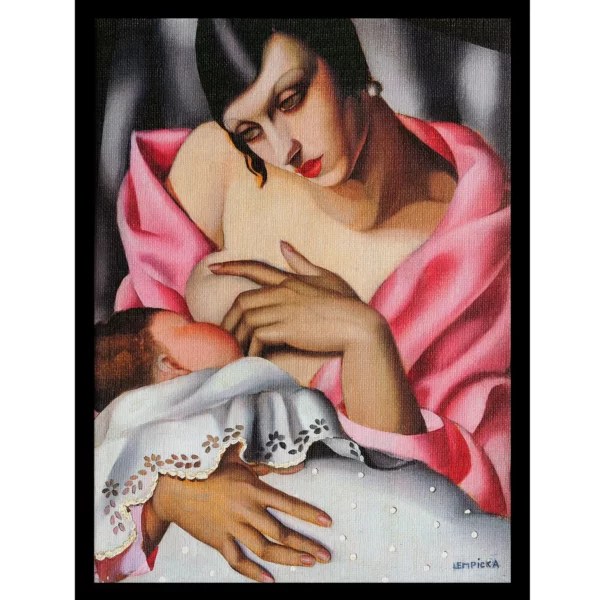
Tamara de Lempicka, “Maternity” (1928) © Tamara de Lempicka Estate LLC
Once again, I am here.
Every night, I am forced to remove my garments for an infantile who doesn’t deserve it. No please, no thank you. There’s no warm tea waiting by the fireplace. No fresh robe hanging by the door, greeting me into my sanctuary. Only screams and cries — dressed up as a polite “welcome home.”
I can’t comprehend what’s so wonderful about my sore, aching breast — fuller than the mouth latched to it. Its own dress, by now, is softer than anything my body will ever be again. If not for the teeth clenching my skin, the earrings tugging my swollen earlobes, or the heaviness of the greediest baby alive — I might have fallen asleep. But no. Every night, I return home, and I provide.
I wonder what my milk tastes like. How delicious it must be, to inspire such brutal insistence. Maybe it’s as sweet as a lollipop. Or like the champagne they served tonight, poured into fluted glasses like it was holy water. I remind myself of the sensation of sipping slowly, letting the bubbles remind me I was alive.
Tonight.
Last night.
The night before.
Every night, I am the star, the one which is served precious liquids on demand. No please, no thank you. And every night, I am pulled away from my spotlight to sit in the shadows of exhaustion — in the house of horrors I once called home. Now a prison I made myself. The lipstick was still perfect when I left. Now it bleeds into the creases of my mouth, cracking like old plaster.
Every night, I fulfill my duties.
Will I ever get a night off?
Reflection:
This piece was written as a visceral response to “Maternity” by Tamara de Lempicka — a painting that captures, with striking clarity, the tension between sensuality, sacrifice, and the idealized image of motherhood. I wanted to explore the unseen labor behind the glossy façade — the way society reveres mothers in concept, while quietly expecting them to vanish into their role. The story is not a rejection of care, but a meditation on what is taken for granted when a woman becomes a symbol. How easily we romanticize the mother without listening to her fatigue, her memories, her hunger for something beyond devotion. This is not about blaming the child. It’s about allowing space for the mother to be complex, flawed, tired, and still worthy of a night off — even if only in her dreams.
Tamara de Lempicka:
Tamara de Lempicka (1898–1980) was a woman who painted like a sculptor and lived like a myth. Born Maria Górska in Warsaw to a wealthy Polish family, she was raised between privilege and cosmopolitan sensibility. After the Russian Revolution, she fled to Paris, where she transformed herself — name, style, and spirit — into Tamara de Lempicka: icon of the avant-garde.
In 1920s Paris, Lempicka carved her place in a male-dominated art world with razor precision. While other modernists deconstructed the body, she refined it — creating women in oil and pigment who were angular, sensuous, and untouchably cool. Her paintings fused cubism’s geometry with elegance, a cocktail of contradictions that mirrored her own life — as she moved between the wild freedom of the art world and the luxury of high society. Openly bisexual and proudly independent, she often painted women like herself: strong, glamorous, and in control. In many ways, Tamara didn’t just create art — she became it.
Her women — often lovers, models, or herself — are not passive muses. In works like Young Lady with Gloves (1929), La Belle Rafaëla (1927), or Autoportrait: Self-Portrait in the Green Bugatti (1929), they possess a hyper-modern aura: stylish, sexual, and inscrutable. Even in Maternity (1928), one of her few maternal portrayals, the softness of the subject is cut with composure.
Lempicka’s work was celebrated during her lifetime, collected by the aristocracy and the newly rich. But as tastes shifted post-WWII, her art faded from public memory — until a revival in the 1970s and ’80s, championed by fashion designers, pop stars like Madonna, and a new generation of queer feminists and collectors drawn to her unapologetic sensuality and control.
To engage with Tamara de Lempicka’s art today, is to witness a woman constantly building herself — in brushstrokes, in lovers, in armor. It is to feel the tension between performance and vulnerability, beauty and burden. And it is to ask: what lies beneath the gloss?
Special thanks to Allyhs from Seeding Freedom festival who inspired this practice.
 THIS MIGHT BE ABOUT ART
Leave a comment