From the Petri Dish to the Canvas, Fungus and Bacteria are “Cultured“

Gala Porras-Kim, “Out of an instance of expiration comes a perennial showing” (2022) © courtesy of the artist; photograph Andy Keate; exh. Gasworks, London
It was the first time I had to walk through a plastic sheet to enter a museum room. That feeling of heavy flaps brushing the side of your forearm as you squeak your way in — for me, is usually reserved for entering greenhouses or the working line of a food factory. The room’s temperature wasn’t far off: moist, but not too warm. You could feel the wetness in the air, like a steam sauna that’s been steaming for a while, and the smell of mud and earth was deep in my nostrils. That smell sent me straight back to my teenage years, camping with friends, foraging mushrooms, climbing trees, sitting on the ground, hearing insects buzz by — maybe those very insects were in the room?
I don’t remember ever being in such an environment inside a museum, where the physical sensations — the smell, the humidity — are an inseparable part of the art piece itself, not just its environment.
As I got closer to the center of the installation, I finally found the source of the smell: bacteria, fungus, wet wood, insects, and live flowers, living-dying non-human organisms forced into this space, now taking over, growing and dictating what we’re looking at. I found a “clean” corner between the wood pillars and crouched down for a closer look. I was fascinated by the way the fungus grew on the wood, building its kingdom of moss and flesh. Like in Closer to Nature – Building with Fungi, Trees and Mud at Berlinische Galerie (2024), where architecture and nature collaborate, using living organisms as building materials. Dan Lie’s spore-disciplinary installation, The Reek (winner of the Preis der Nationalgalerie 2024), uses the same materials to create living art.
And it wasn’t the first time I saw this approach. I remembered MYKOLOGICA at OKK, where fungi were used as metaphors for peace. There, mushrooms grew inside sculptures and paintings. They weren’t objects—they were inhabitants. At the GRASSI Museum in Leipzig, mold was turned into a material for soundproof walls. Becoming Mycelial at KH7 in Aarhus mixed research, storytelling, and science into a whole ecosystem of spore-sensing installations. Everywhere, mushrooms were making themselves at home.
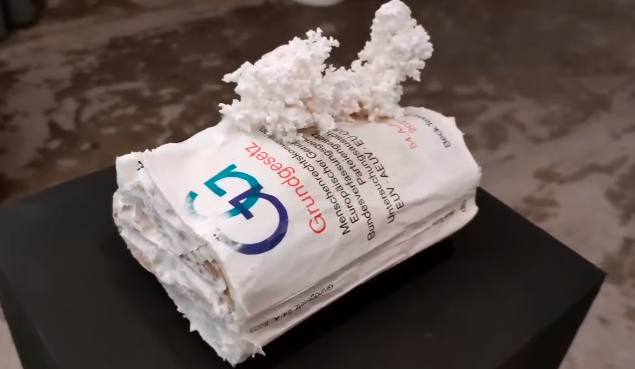
Richard Clauss Grundgesetz als Substrat, featured at MYKOLOGICA III (2024) © Photo taken from OKK/Raum29 Instagram.
Fungi growing through a Grundgesetz (German Basic Law) book is a powerful image. One that blends environmental urgency, political critique, and existential irony. Whether it’s framed as protest, poetic decay, or fungal futurism, it asks: what grows when the structures we trust begin to rot?
Just weeks previously, I was in the countryside with friends, enjoying a taste of psilocybin. I found myself wanting to touch grass, feel mud under my fingernails, and stare at ants crawling. Standing here, looking at this fungus, I was drawn to do the same. But unfortunately, the security guard was watching. In a world where art is precious and not to be touched, why did I want to touch this so badly? And why, in this room that smells like it needs a good cleanup, is rot celebrated? Why does context change how we react to bacteria? Are we creating a hierarchical system for eukaryotes?
But it was Territory at Sprüth Magers that really hit me. It was Berlin’s first group show of only Asian female artists—a big moment. The exhibition explored “territory” — physical and psychological borders that both constrain and liberate — through decaying material. In that show, Gala Porras-Kim presented Out of an instance of expiration comes a perennial showing (2022-ongoing): a live sample of mold from the British Museum’s collection, carefully encased in glass. At first, I was shocked, almost ready to call the health department. That mold, collected from the museum’s storage, propagated right there in the gallery, behind glass, too precious to be nakedly displayed, or too dangerous to directly inhale.
It felt like looking into a sacred relic. At the same time, I thought about the mold that grows in my flat if I don’t clean for two days. Why does one disgust us, and the other deserve preservation? What makes something art? And why do we insist bacteria must be hidden unless it’s curated?
Standing there longer, I felt the contradictions deepen. That mold wasn’t just about decay. It was about time, neglect, colonial power, and preservation. A moment that shouldn’t have been saved, but was. A slow, quiet rebellion against museum protocols. Against forgetting.
I remembered how as a kid, my grandmother took me to her microbiological work lab, showing me petri dishes full of spores. I was amazed but also confused: if spores are so natural and fascinating, why do I hesitate when they’re alive in front of me? Why does the glass lid stand between us, evoking caution?
In Porras-Kim’s work, layered politics emerge: preservation, colonial collection, and institutional authority. By extracting mold from museum artifacts and placing it in the gallery, she flips the script; what was hidden, controlled, and sterilized is now growing and asserting itself. The glass case becomes a symbolic barrier between past and present, institution and viewer, artifact and organism. This confrontation with decay and discomfort echoes through the exhibition. Fungus, both literal and metaphorical, weaves through the works, inviting us to reconsider boundaries: culture and nature, structure and collapse, art and rot.
There’s something fundamentally curious about mold. It doesn’t respect borders or binaries. It lives in in-between spaces, neither plant nor animal, never really dead or alive. It just keeps becoming. That’s what I love about it. It resists ownership, definition, control.
Initially, I was prone to discussion. But the longer I spent with these works, the more the idea grew on me. Fungus is always there, quietly thriving in the background of an ever-changing world. We’re now seeing mycelium used in textiles, architecture, even soundproof walls. Art practices, too, are catching on, following this movement toward sustainable, living materials.
And of course, in contemporary art, context is everything. These moldy works ask: what’s allowed to grow, and what must be cut away? What’s framed, and what’s ignored? They challenge what we call clean, valuable, or beautiful. They rot the hierarchy. They compost the frame. They are reminding us, that we are not as separate from the dirt as we like to think.
References / Sources:
- Preis der Nationalgalerie 2024: Dan Lie – Staatliche Museen zu Berlin
- Closer to Nature – Berlinische Galerie
- Fungifacturing Art – Fraunhofer Art + Design
- MYKOLOGICA III – Kritische Kunst
- Becoming Mycelial at KH7 – Mycelial Space
- Territory – Group Exhibition, Berlin – Sprüth Magers
 THIS MIGHT BE ABOUT ART
Leave a comment