On Ancestry, Collapse, and the Oceanic Call in Jafa and Owuor

©2025 Arthur Jafa, Courtesy of the artist, Gladstone Gallery and Sprüth Magers
“Woooooow!”
A young girl gasped as she walked into the space where Arthur Jafa’s AGHDRA (2021) was installed, at Bourse de Commerce, Paris. A vast, empty hall. A few stairs to sit on. And at its center—a large (but not massive) screen, suspended on a wall far larger than itself. It didn’t need to fill the wall to overwhelm the room. What it showed was an ocean—or what might once have been one. A black, heaving surface of magma, rocks, oil spill, space-trash—alien and familiar all at once. Within moments, the space was devoured. And so were we.
I wasn’t alone. I had come with a friend—someone I knew I wouldn’t see again for a long time. That knowledge sat inside the room with us, swelling alongside the waves. It wasn’t just the sea that overwhelmed me—it was the knowing. Of what’s ending, what’s always drifting.
This is not a new work. AGHDRA premiered in 2021 and has been widely written about by critics like Aruna D’Souza and Linda Yablonsky, and featured in Artnet, The Art Newspaper, and others. Still, we feel the need to speak. Because AGHDRA is not something you simply see—it pulls you under.
And sometimes, it pulls you back.
Earlier this year, I had a terrible accident. A wave swallowed me off the coast of Portugal. I broke my leg and had to swim out, one limb limp and useless. I remember thinking I might not make it—each stroke felt impossible.
Watching AGHDRA, I was suddenly back in that moment—scared, breathless, unsure I’d be able to swim through. The screen wasn’t just showing the ocean. It was becoming it. Or was I?
Jafa, best known for works like Love Is the Message, The Message Is Death (2016) and The White Album (2018), has long worked with the affective power of the image—especially in relation to Black life, Black music, and Black trauma. But AGHDRA is a pivot. There are no human figures here. No archival cuts, no found footage, no fast montage. Only an endless sea.
The voice in AGHDRA repeats a simple but seismic question:
“Who am I?”
Over and over, it trembles under the weight of the ocean, under the ceiling of toxic sludge.
It’s a question that doesn’t demand an answer—it haunts.
The repetition feels both ancient and futuristic, like a spiritual loop glitched through time. It doesn’t progress—it accumulates. The words stretch and decay in the bass, like a soul trying to rise but sinking instead. Here, identity isn’t a stable thing. It’s sediment, layering over trauma, memory, resistance, and residue. This is not the self in a mirror. This is the self in a tide.
The echo of that question took me directly to The Dragonfly Sea (2019), Yvonne Adhiambo Owuor’s oceanic epic. The novel follows Ayaana, a Kenyan girl coming of age on the island of Pate, as she is swept into a life of spiritual visions, cross-continental heritage, and maritime destiny. The Indian Ocean in Owuor’s novel is not simply background—it’s a living force, a keeper of memory and mystery.
Throughout the book, Ayaana feels the ocean speak to her. It asks:
“Who are you?” (In Chinese: Nǐ shì shuì?)
It is not the same question repeated in AGHDRA, but it is a twin.
In The Dragonfly Sea, the ocean is maternal, mythic, and sometimes menacing. It calls Ayaana toward something older and deeper than she understands. She is not only asked to know who she is, but to answer back to an ocean that carries centuries of migrations, wars, rituals, and silences. Like Arthur Jafa’s ocean—thick with oil, history, and grief—it holds time in suspension. It too remembers, insisting that the past is never truly past, only submerged.
Owuor is a Kenyan writer whose work blends mysticism, postcolonial narrative, and epic scale. The Dragonfly Sea stretches from Pate Island off the coast of Kenya, across the Indian Ocean to Oman, China, and back. It weaves together personal transformation and transoceanic histories—Swahili, Arab, Chinese, and African—into a web of ancestral remembering. It is a novel obsessed with drift, with what gets lost in the waves, and what clings to us across continents and centuries.
When the voice in AGHDRA asks “Who am I?”, it’s not personal introspection. It’s ontological crisis. It’s a voice caught between worlds—between visibility and erasure, body and debris, sound and silence. And when it echoes in tandem with Owuor’s sea asking “Who are you?”, the dialogue becomes cosmic. It’s as if Blackness itself is being asked to explain its origin story, while trying to survive inside someone else’s collapse.
The ocean in Owuor’s world holds not only salt, but ghosts.
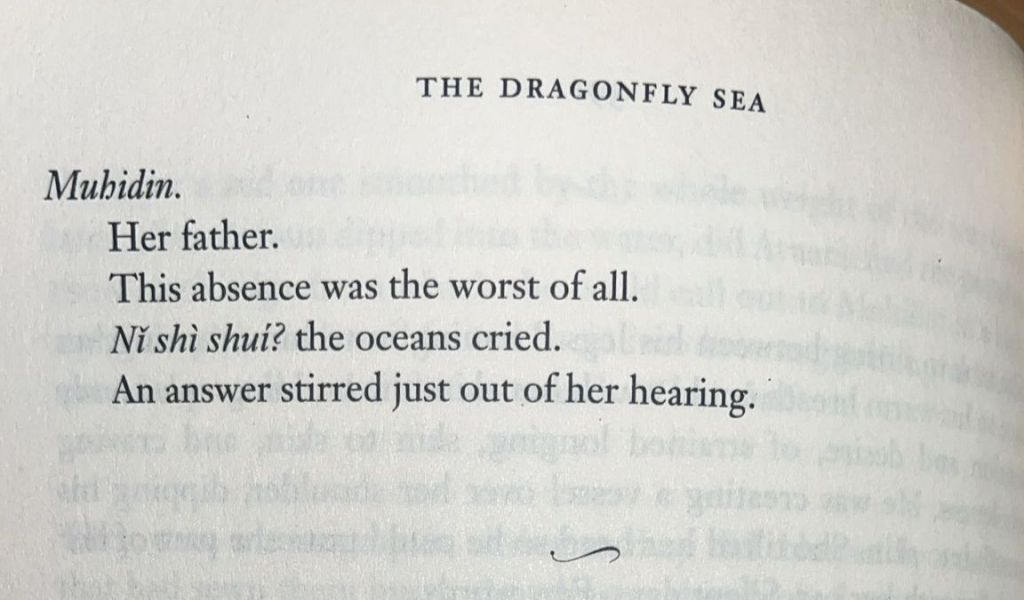
That question in The Dragonfly Sea is not just existential—it is ancestral. The Indian Ocean becomes a force of belonging and dislocation, simultaneously. It calls Ayaana into deeper knowing, but also estranges her from the surface world. This mirrors the atmosphere in AGHDRA, where the black ocean both cradles and consumes. Identity isn’t a stable thing in either work—it’s a drifting vessel, shaped by trade winds, migrations, oil spills, and grief.
Owuor speaks of the ocean as an inheritance with no map. Jafa, too, offers no navigation—only immersion. In both works, the waters do not part. They rise. They pull us in.
The voice in AGHDRA is not just human. It’s planetary. It belongs to the same current that Owuor describes: not the “Middle Passage” of Atlantic trauma that Jafa’s previous works often allude to, but a different tide—one blackened by time and residue, shimmering still.
And yet here, the ocean is poisoned. Blackened. The waves look thick, too heavy to breathe in or out. They shine with a sick beauty—like oil spilled across water, slick and luminous. We’re taught to see oil spills as disgusting, catastrophic, deathly. And they are. But in AGHDRA, Jafa doesn’t turn away. He lets that slickness gleam. The poison becomes the light. Terrifying, and captivating.
Sitting there beside someone I knew I’d be leaving soon, it felt like the ocean was asking all of us—not just “Who are you?”, but “Who were you to each other?” The moment became unrepeatable. Tender. And already gone.
We stayed. Not talking. Just listening. Letting it ask us.
There is no resolution. No climax. The waves go on. The voice keeps asking. The ceiling does not break.
“Woooooow,” the girl said, again.
 THIS MIGHT BE ABOUT ART
Leave a comment