Suzanne Duchamp at Schirn Kunsthalle, Frankfurt Am Main
© Suzanne Duchamp / 2024, ProLitteris, Zurich
The sentence stands there on the wall before you even enter. A provocation, maybe a compliment, maybe a dismissal — it’s hard to tell. I read it twice before stepping inside, wondering how it must have felt to have those words said about you, by a man, by a fellow artist.
Inside, the space feels unexpectedly grounded. Schirn Kunsthalle is working out of a temporary location during renovations, but nothing about it feels temporary. The light is soft, the rooms carefully shaped. It’s quiet, but not sterile — like the kind of quiet where you can hear your own thoughts echoing back.
The exhibition brings together an impressive selection of works from various collections — Musée des Beaux-Arts de Rouen, Kunsthaus Zürich, several private owners, and a few more institutions. You can sense the curators’ effort to assemble this constellation of pieces, creating a rare opportunity to see Duchamp’s artistic trajectory unfold in one place.
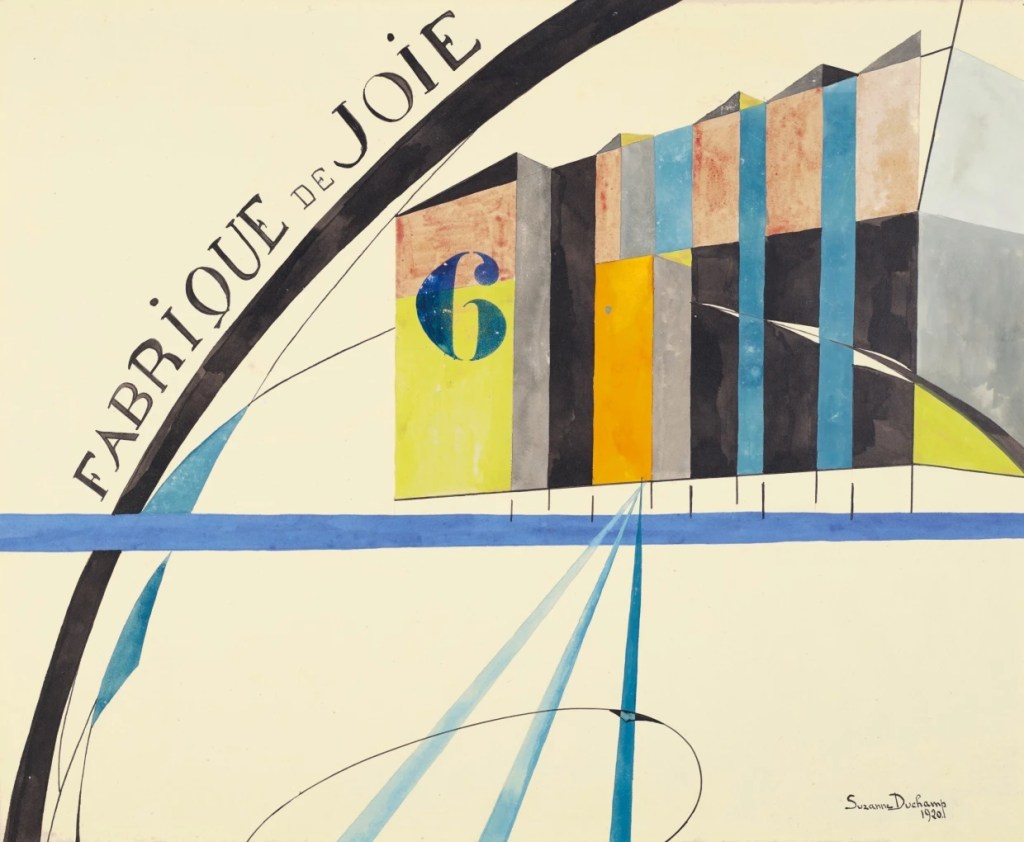
The first room hums with energy. Paintings from Duchamp’s Dada years — factories, pipes, metal lines — all alive and moving. She paints industry not as something cold or hard, but as something curious, thinking, joyful. The metallic paint catches the light like sunlight on machinery. Standing in front of Fabrique de Joie (1920), “Factory of Joy”, I thought of The Wall (1982). That scene — “Another Brick in the Wall” — where the children march toward the grinder. The rhythm, the repetition. But Duchamp’s version does something else. Her factory doesn’t crush — it creates. It manufactures joy. She takes the same mechanical logic that can destroy individuality and turns it into something that celebrates it. I stood there thinking how even now, a century later, we’re still trapped in that same loop: building, producing, searching for meaning inside the machine.
One line in the wall text mentions that Duchamp “helped invent collage.” I like how confident that sounds, but it also makes me wonder how much she was really involved in that process. From the show, she seems to have been an active Dada artist, contributing, experimenting — but not exactly central. The exhibition clearly wants to give her the space she never had, to make her as important as her male counterparts. It reminded me of Linda Nochlin’s question, “Why have there been no great women artists?” Maybe this show is part of rewriting that answer.
As you move through the next rooms, the energy softens. After 1922, when she left Dada, her work loosens its grip. The sharp lines melt into rounder forms, softer movements, and quieter tones. It’s as if she finally gave herself permission to breathe. Figures appear — not perfect, not idealized, but human, funny, sometimes melancholic. There’s irony, but it’s gentle now, not shouted. The compositions still hold together, but with more air between them, as if the brush had learned to trust itself.
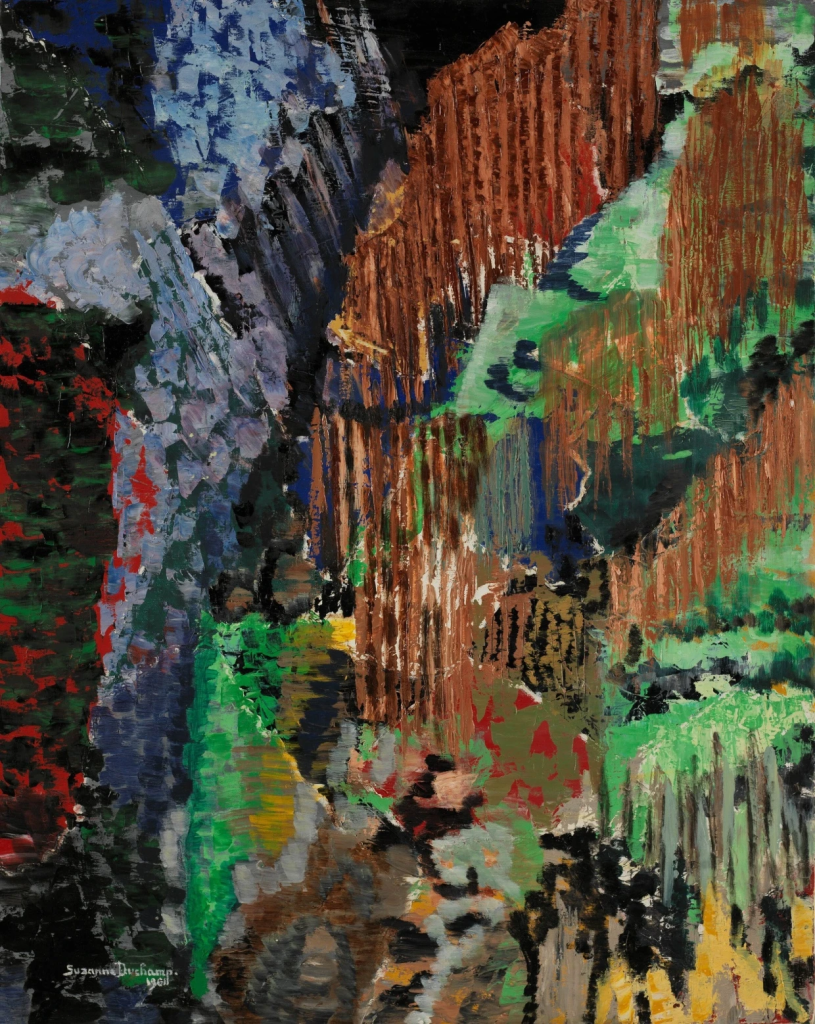
And then comes Le Monde Souterrain (1961). I stopped in front of it for a long time. The title means “underground world,” and that’s exactly what it feels like — a descent into memory, color, and silence. The colors bloom out of darkness, rich and deep, but never loud. There’s something fertile there, like soil after rain. You can almost feel her moving inward — away from noise, from theory, from the machine — into something more instinctive. The painting doesn’t try to impress; it just exists, glowing quietly from within.
By this point, you start to forget where one period ends and another begins. The layout helps with that — freestanding walls let you wander, drift, lose track of time. I loved that. It felt honest. Growth is never linear; it loops and folds and contradicts itself. Duchamp’s work feels the same — an ongoing conversation with herself.
When I finally left the last room, I found myself back at the beginning. The quote waited on the wall again:
“Suzanne Duchamp does more intelligent things than paint.”
And then I thought — yes, that’s true. What she did wasn’t just paint, but think through color, dream through form, feel her way into freedom. There’s intelligence in that — but also defiance, grace, and an unwavering tenderness.
The show runs until January 11th, 2026. If you find yourself in Frankfurt, go. Not just to see the art, but to walk slowly through her world — from the noise of the factory to the quiet of the underground, from the system to the self.

 THIS MIGHT BE ABOUT ART
Leave a comment