A trip through memories at Studio DB
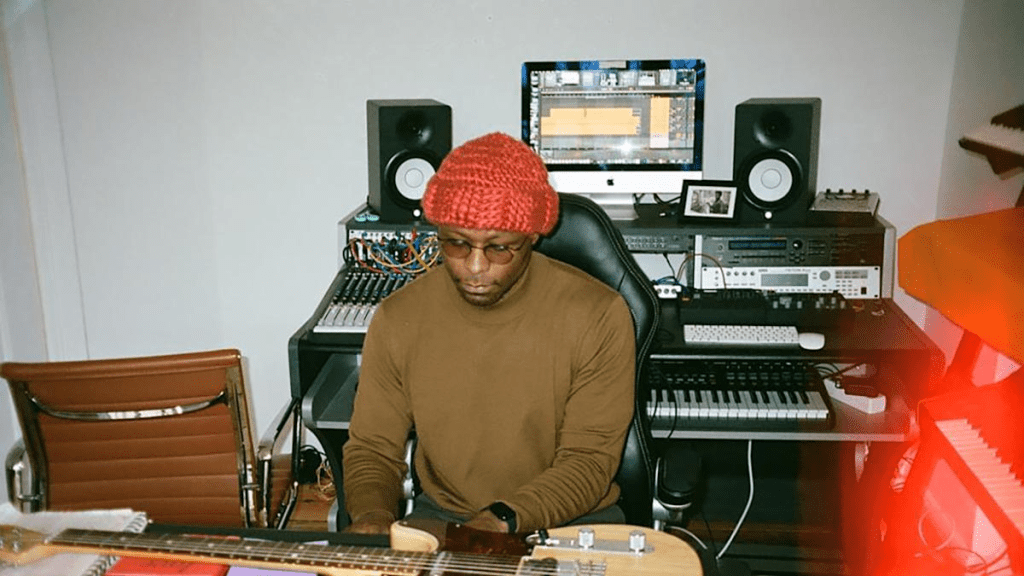
The other night at Studio DB felt like stepping into someone else’s dream — or maybe their memory, fragmented and replayed in loops that never quite land where you expect them to. Prototypes: Live Fragments by Oscar Atanga unfolded like an echo chamber of sound, image, and time — a modular performance built from recordings across Benin, Senegal, and Berlin, yet suspended somewhere between all three.
Atanga stood illuminated the entire time — not hidden behind a screen or dissolving into the shadows like most VJs or live composers tend to. He was there, a character in his own film, bridging the world on screen and the world we sat in. It gave the work a sense of immediacy, of being part of the narrative rather than controlling it from afar. His presence felt deliberate, almost like an anchor — though the piece itself kept drifting, flowing between colours, textures, and states of mind.
The visuals were lush and tactile — like watching a memory being stitched back together by hand. On screen, craftmakers appeared: their fingers steady, sewing, threading, yielding. You could almost hear the rhythm of their breath between stitches, the rustle of fabric folding in on itself. Each gesture felt ritualistic, as if they weren’t just making clothes but weaving fragments of identity — the kind that cling to you even after oceans and languages have shifted around your name.
Then the scenery shifted. Green swallowed everything. The air thickened. We were in the jungle now — that dense, humid silence where sound itself seems to sweat. And through it, softly but unmistakably, came the low mechanical hum of the U-Bahn, bleeding into the birdsong. A collision of worlds: Berlin sneaking into West Africa, modernity intruding on memory. It was haunting — the way these frequencies overlapped, neither one canceling the other. Just coexisting, uneasily, like the layers of one’s own history.
Then I noticed something — his clothes. The same terracotta-orange blouse and wide royal blue pants he wore on stage kept appearing in the film: sometimes folded neatly, sometimes hanging from a branch or window frame, sometimes just there for a moment before disappearing again. They seemed to travel with him, crossing scenes like quiet reminders of presence.
It gave the piece a quiet intimacy, this doubling — as if the version of him on stage and the one on screen were moving through parallel timelines, occasionally brushing against each other. The colours became markers, grounding the work in something tactile amid all the abstraction. Those garments weren’t symbolic or theatrical; they simply existed — carrying traces of the journey, of repetition, of a life lived between places.
There was beauty in that repetition — and also fatigue. Around the 45-minute mark, I realized I had stopped following the thread. The performance kept looping back, replaying familiar images with slightly altered sounds, like life seen from a new angle but saying nearly the same thing. Maybe that was the point — the way migrants and drifters reassemble their pasts through shifting contexts — but part of me longed for a rupture, a new form within the fragments.
A sudden speech appeared near the end, mostly in a language I didn’t understand, then briefly in English. It felt charged, political even, but too fleeting to grasp — a message that got lost in translation, or maybe intentionally withheld. The guitar section that followed was stunning though — sharp, soulful, a sonic exhale after all that density.
In the end, Prototypes: Live Fragments felt less like a concert or film and more like inhabiting someone’s process of remembering. A collage of migration and memory, of how the sounds of home — laughter, engines, sewing machines — fuse with the noise of where we’ve landed. Studio DB’s raw walls and low light amplified that feeling; it was intimate, heavy, and alive.
It’s a piece that doesn’t ask to be understood linearly — it circles itself, breathes, contradicts, and sometimes overstays its welcome — but maybe that’s the truest part of it: the experience of belonging everywhere and nowhere at once.
 THIS MIGHT BE ABOUT ART
Leave a comment